How do you quantify conviction?
Good companies are not hard to find, but cheap ones are. To have high conviction that we will get paid, we need to understand why the market is wrong and how to validate our thesis when the time comes.
The hardest part about investing for me has been turning qualitative observations into something quantitative and actionable. After running a model, I might feel great about the base case for the next quarter, but my valuation depends hugely on long-term performance—this is something I am far less certain about.
Is there a way to outsource my conviction?1
How do you disagree with Street?
In trying to understand how some of my very talented peers invest, I’ve gathered that everything seems to boil down to a few key debates and where people stand on those debates. We’ll try to find some data to support our views on those debates. Maybe we make a call or two, look at some alternative data, or read analyst reports.
But two people with access to the same data might still disagree. There’s something about us as people with unique world experiences that biases (non-pejoratively) us toward different interpretations of the same information. I think this is what makes investing so exciting.
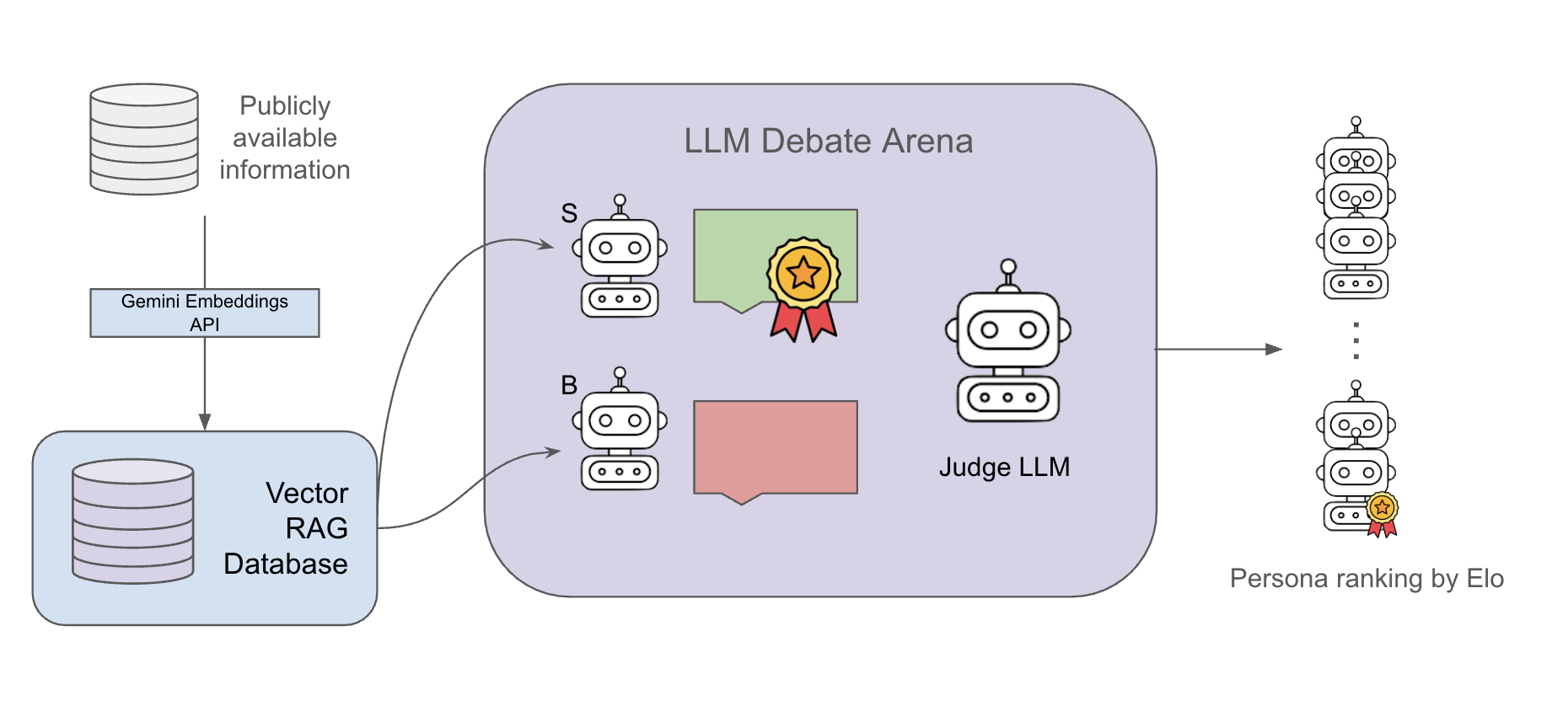
I built the Parliamentary Debate Engine to go about the process in the other direction. Given a set of information and a few distinct personas that we identify before the fact, can we see which arguments are likely to play out?
The project simulates parliamentary-style debates using LLM agents and a RAG database. By tracking the relative win rates of different personas over thousands of simulations, we can arrive at a quantification of a particular argument’s “delta to consensus.”
Vibe investing?
I will never read a 10k in the shower, but Claude will. Extracting information from earnings calls and business conference transcripts feels like drudgery to me, but any LLM I can make an API call to nowadays will do it in a couple of seconds.
The edge has been and will always be information, but the internet, credit card data, and expert calls will become increasingly easier to process.
I think the differentiator in the coming years will be idea quality. If we can model the debates, we can better model the price.
Acknowledgements
Thanks to Sean-Winston Luo, Papa Mensah, and Kate Wei for being a great pitch team and to Point72 for hosting us as finalists in their national stock pitch competition!
Code can be found here.
Footnotes
without hiring a consulting agency↩︎